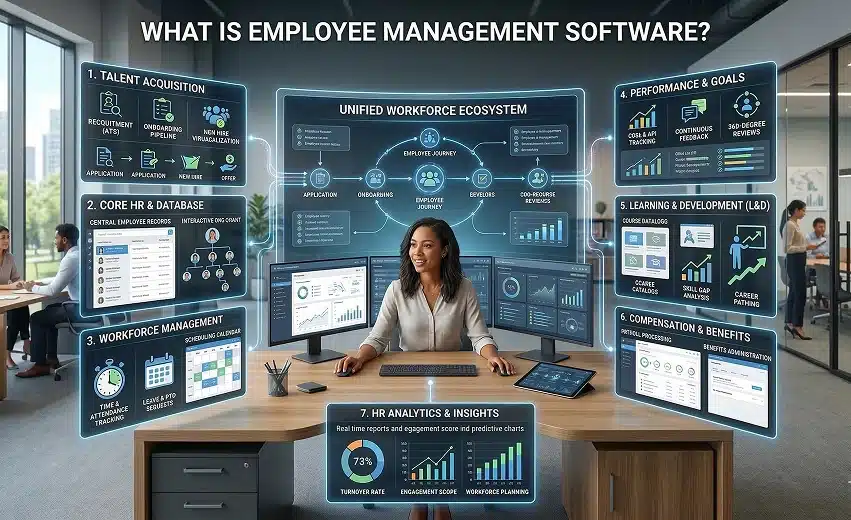

Employee management software is a centralized digital platform that helps organizations manage employee information, automate HR processes, and monitor workforce activities from a single system.
It enables HR teams to handle attendance tracking, payroll processing, performance evaluation, and employee data management more efficiently, while significantly reducing manual administrative work.
Whether you're managing a lean startup team or a large enterprise workforce, modern workforce management software and HR tools help organizations run smoother, make smarter decisions, and improve overall productivity.
⚡ TL;DR (5 min read)
Employee management software is a centralized digital platform that automates HR operations, consolidating attendance tracking, payroll processing, performance management, and employee records into a single system. It eliminates scattered spreadsheets and manual HR workload while providing real-time workforce visibility. These platforms work best for businesses of all sizes, from small businesses to enterprises, especially those managing remote or hybrid teams. Top tools in 2026 include Desklog, BambooHR, Zoho People, Keka HR, Rippling, Workday, and Darwinbox.
📖 Keep reading for the full breakdown, feature comparisons, and expert buying tips.
📋 Table of Contents
- How Employee Management Software Works, And Why It Matters
- What is an Employee Management System?
- How It Improves Workforce Productivity and Operations
- 5 Key Features of Employee Management Software
- 6 Common Problems Companies Face Without Employee Management Software
- 5 Types of Employee Management Software
- 7 Best Employee Management Software for 2026
- How to Choose the Right Employee Management Software
- Employee Management Software vs HR Management Software: Key Differences
- Future Trends in Employee Management Software
- Conclusion
- FAQs
How Employee Management Software Works, And Why It Matters
Managing a growing workforce isn't easy, especially when HR teams are buried under spreadsheets, manual attendance logs, and disconnected payroll systems.
That's exactly where employee management software steps in.
In simple terms, it's an all-in-one digital solution that helps organizations streamline HR operations, centralize employee data, and automate the repetitive tasks that consume hours of productive time every week.
Whether you're running a 50-person startup or a 5,000-employee enterprise, the right platform can fundamentally transform the way your HR team works.
What is an Employee Management System?
An employee management system is a centralized digital platform built to organize, store, and manage everything related to your workforce, from the moment a new hire joins to the day they retire or resign.
Think of it as the operational backbone of your HR department.
Instead of juggling multiple tools, spreadsheets, and filing cabinets, HR professionals get a single unified system that handles it all. Here's what a robust employee management system typically covers:
- Centralized employee records: Store and access accurate employee profiles, documents, and employment history from one secure location.
- HR task automation: Eliminate repetitive manual work like data entry, leave approvals, and payroll calculations.
- End-to-end lifecycle management: Support every stage of the employee journey, from onboarding and training to performance reviews and offboarding.
- Data accuracy and security: Reduce human errors and ensure sensitive workforce data is protected with proper access controls.
The result? HR teams spend less time on admin work and more time on what actually matters—people.
How It Improves Workforce Productivity and Operations
Beyond just storing data, employee management platforms play a direct role in boosting workforce productivity and improving day-to-day operations across the organization. Here's how:
- Real-time workforce visibility: Managers get instant access to employee attendance, work hours, leave status, and performance metrics, no chasing down reports or waiting until end of month.
- Reduced administrative burden: By automating routine HR processes, teams save significant time and redirect energy toward strategic initiatives.
- Smarter team management: Supervisors can monitor individual and team productivity, identify bottlenecks early, and make informed decisions backed by live data.
- Streamlined HR workflows: From onboarding checklists to payroll runs, automated workflows minimize delays, reduce errors, and keep operations running smoothly.
When HR inefficiencies are removed from the equation, the impact ripples across the entire organization, employees are more engaged, managers are better informed, and business operations become noticeably more agile.
5 Key Features of Employee Management Software
Employee management software includes a variety of tools that help HR teams manage workforce operations more efficiently. These platforms centralize employee data, automate administrative tasks, and provide insights that support better decision-making across the organization.
-
Employee Database Management
Stores and organizes all employee information, including personal details, job roles, employment history, and key documents, in a centralized system for easy access and real-time updates.
-
Attendance and Leave Tracking
Automatically tracks employee work hours, shift schedules, and leave requests, helping HR teams maintain accurate attendance records and streamline leave management without manual follow-ups.
-
Performance Management
Allows managers to monitor employee productivity, conduct structured performance reviews, and track progress toward individual and team goals, supporting continuous employee development across the organization.
-
HR Analytics and Reporting
Generates reports and actionable insights on workforce data, enabling HR teams to analyze attendance trends, employee performance, and overall organizational productivity at a glance.
-
Employee Self-Service Portals
Gives employees direct access to their own HR information, including payslips, leave applications, personal detail updates, and attendance records, without needing to contact HR for every request.
💡 Modern HR systems sync time and attendance data directly with payroll, reducing manual errors and improving accuracy across the entire workforce management process.
👉 Want to see these features in action?
Request a Free Demo6 Common Problems Companies Face Without Employee Management Software
Organizations that rely on manual HR processes often struggle to manage their workforce efficiently. Without a centralized system, HR teams face recurring operational challenges that directly impact productivity, accuracy, and overall business performance.
- Scattered Employee Data: Employee information spread across spreadsheets, emails, and paper files makes it difficult for HR teams to access, update, or audit records quickly and accurately.
- Attendance and Time Tracking Errors: Manual tracking leads to inaccurate work hour records, payroll discrepancies, and potential compliance issues that are difficult to resolve after the fact.
- Payroll Processing Delays: Without automation, payroll calculations become time-consuming and highly prone to errors in salary, tax deductions, and bonus processing.
- Limited Visibility into Employee Performance: Without proper monitoring tools, managers struggle to track productivity fairly and consistently across teams.
- Increased Administrative Workload: HR teams spend too much time on repetitive tasks that could otherwise be handled automatically, significantly reducing focus on strategic, people-first work.
- Difficulty Managing Remote or Hybrid Teams: Without dedicated digital tools, monitoring attendance, productivity, and team collaboration becomes a serious challenge in remote and hybrid work environments.
These challenges are exactly why modern organizations are increasingly adopting employee management software, to eliminate manual bottlenecks, simplify HR operations, and build a more efficient workforce management process.
5 Types of Employee Management Software
Employee management software comes in different categories, each designed to handle specific HR and workforce management functions. Understanding these types helps organizations choose the right tools based on their size, industry, and operational priorities.
1. HR Management Systems (HRMS)
Comprehensive platforms that manage core HR activities, including employee records, recruitment, onboarding, payroll, and performance management. HRMS software centralizes all HR data and automates multiple processes within a single system, making it ideal for mid-to-large organizations.
2. Workforce Management Software
Focused on optimizing employee productivity and operational efficiency, these systems help organizations manage work schedules, attendance, shift planning, and labor allocation, while providing real-time insights into team performance across departments.
3. Time Tracking Software
Helps organizations monitor employee work hours, track project time, and record attendance accurately. Time tracking tools are especially valuable for remote teams and businesses that need precise tracking of billable hours and project-based work.
4. Employee Performance Management Software
Helps managers evaluate employee productivity, set measurable goals, conduct performance reviews, and track progress over time. These tools support employee development and help identify high-performing individuals across the organization.
5. Payroll Management Systems
Automates salary calculations, tax deductions, bonuses, and payslip generation. By eliminating manual calculations, payroll systems ensure accurate processing and timely employee payments, removing one of the most error-prone HR tasks from the equation.
Together, these solutions serve as essential workforce productivity tools that help businesses manage employees more efficiently and drive better results across the organization.
7 Best Employee Management Software for 2026
With dozens of platforms on the market, choosing the right tool can feel overwhelming. To make it easier, here are the top employee management software platforms HR teams are relying on in 2026, each offering a unique set of strengths.
1. Desklog
Desklog is a workforce productivity and time-tracking platform designed to help organizations monitor employee work hours and productivity in real time. It offers automated time tracking, attendance management, project tracking, and detailed productivity reports. What sets Desklog apart is its employee wellness module, designed to encourage healthier work habits by monitoring break patterns and overall employee wellbeing. It's particularly well-suited for managing remote and hybrid teams with precision and ease.
2. BambooHR
A popular HR management platform built for small and medium-sized businesses. BambooHR provides tools for employee data management, onboarding, leave tracking, performance management, and HR reporting, helping HR teams stay organized while cutting down on admin workload.
3. Zoho People
A cloud-based HR software solution offering employee database management, attendance tracking, leave management, and performance evaluation features. Zoho People integrates seamlessly with other Zoho applications, making it a natural fit for companies already operating within the Zoho ecosystem.
4. Keka HR
Keka HR simplifies payroll, attendance management, and employee engagement through automated payroll processing, performance tracking tools, and self-service portals. It's particularly well regarded for improving HR transparency and reducing manual bottlenecks within growing organizations.
5. Eletive
Eletive is a modern employee engagement and performance management platform built to help organizations turn employee feedback into meaningful action. Designed as a “People Success Platform,” it combines real-time pulse surveys, AI-driven insights, and performance tools like OKRs, 1:1 meetings, and 360° feedback into one unified system.
6. Workday
An enterprise-level human capital management platform designed for large organizations. Workday offers advanced HR analytics, workforce planning tools, payroll management, and AI-driven insights, built to manage complex, multi-location workforce structures at scale.
7. Darwinbox
A modern HR technology platform that helps organizations manage recruitment, onboarding, payroll, attendance, and performance. Its cloud-based architecture supports automation and delivers HR analytics that improve workforce decision-making at scale.
👉 Not sure which platform is right for your organization?
See How It WorksHow to Choose the Right Employee Management Software
Selecting the best employee management software means evaluating how well a platform aligns with your organization's size, existing workflows, and long-term growth plans. Here are the five key factors every HR team should assess before making a decision:
-
1. Company Size Compatibility
Choose software that matches your current workforce scale. Small businesses may need simple tools for attendance and employee records, while larger organizations typically require advanced analytics, multi-department management, and deeper integrations.
-
2. Payroll and System Integrations
The platform should connect smoothly with your existing payroll systems and HR tools. This ensures employee work hours, attendance data, and compensation details flow between systems accurately, without manual re-entry or sync errors.
-
3. Reporting and Analytics Capabilities
Strong reporting features help managers track workforce performance, attendance patterns, and productivity metrics over time. These insights are essential for informed workforce planning and smarter operational decisions.
-
4. Automation Features
Prioritize platforms that automate routine HR tasks, including attendance tracking, leave approvals, payroll processing, and employee record updates, to reduce admin burden and minimize the risk of human error.
-
5. Scalability
As your company grows, your workforce management needs will evolve. Choosing a scalable platform ensures it can support more employees, additional departments, and advanced feature modules without requiring a costly system overhaul down the line.
Employee Management Software vs HR Management Software: Key Differences
Both platforms serve the workforce, but they're built for very different purposes. Here's a clear side-by-side comparison to help you decide which solution fits your needs:
| Aspect | Employee Management Software | HR Management Software |
|---|---|---|
| Scope | Focuses on employee activities, attendance, productivity, and work hours | Covers broader HR operations, recruitment, payroll, compliance, and talent management |
| Functionality | Time tracking, attendance monitoring, productivity insights, task tracking | Payroll processing, recruitment, onboarding, employee records, performance management |
| Primary Users | Team managers, supervisors, and operations teams | HR departments and senior administrators |
| Best For | Monitoring productivity, managing work hours, improving operational efficiency | Managing the complete employee lifecycle, from hiring to performance evaluation |
Understanding the difference between HR software vs employee management software helps businesses choose the right solution based on their day-to-day operational priorities, rather than investing in features they don't need.
Future Trends in Employee Management Software
Employee management technology is evolving fast. Here are the key trends shaping the future of workforce management in 2026 and beyond, and what they mean for HR teams today:
- AI-Powered Workforce Analytics: Modern platforms are integrating AI capabilities that analyze workforce data, surface productivity patterns, and generate insights that help managers make better-informed decisions. These tools also support proactive workforce planning by predicting trends and flagging potential issues before they escalate.
- Automation-Driven HR Operations: Automation is steadily eliminating manual HR work, from attendance tracking and leave approvals to payroll processing and employee record management. This frees HR teams to shift focus from administrative tasks to strategic, people-first initiatives that drive real business value.
- Integrated Productivity Platforms: The future points toward unified systems that combine employee management, productivity monitoring, project tracking, and team collaboration in a single platform, giving organizations complete, real-time visibility into daily workforce operations without switching between tools.
- Remote Workforce Management Tools: With remote and hybrid work now a permanent fixture across many industries, remote employee management software continues to evolve, offering more accurate work hour tracking, smarter productivity monitoring, and better team connectivity regardless of location.
Conclusion
Employee management software has become an essential tool for organizations of all sizes, from growing startups to large enterprises, looking to simplify HR operations, reduce administrative workload, and gain real-time visibility into workforce performance.
From automating employee task management and attendance tracking to streamlining payroll and delivering actionable HR reports, the right platform helps businesses, including those seeking employee management software for small businesses, operate more efficiently and make smarter, data-backed workforce decisions.
As HR technology continues to advance with AI, automation, and integrated productivity tools, investing in the right employee management solution today means building a more productive, agile, and people-focused organization for tomorrow.