Best Time Tracking Software in 2026 (12 Tools Tested and Compared)
Finding the best time tracking software can feel like a full-time job in itself. There are hundreds of tools out there, and most of them promise the same things: automatic tracking, detailed reports, and easy setup. So how do you figure out which one actually delivers for your team size, your industry, and your budget?
We spent weeks testing 12 of the most popular time tracking tools across real workflows. We evaluated each one for freelancers, small businesses, remote teams, consultants, and enterprise organizations. This guide breaks down exactly what we found so you can pick the right time tracking software without wasting time on free trials that go nowhere.
Quick Summary: Best Time Tracking Software at a Glance
Short on time? Here is a quick look at our top picks before we get into the detailed reviews. Each tool is mapped to the team type or use case where it performs best.
| Tool | Best For | Starting Price | Standout Feature | ★ Rating |
|---|---|---|---|---|
| Desklog | Teams & small businesses | Free (up to 3 users) | Auto tracking + productivity scoring | |
| Toggl Track | Freelancers & consultants | $9/user/mo | One-click timer | 4.6/5 |
| Clockify | Budget-conscious teams | Free | Unlimited free users | 4.5/5 |
| Hubstaff | Remote teams | $4.99/user/mo | GPS + activity tracking | 4.4/5 |
| Time Doctor | Enterprise & employees | $5.90/user/mo | Distraction alerts | 4.3/5 |
| Harvest | Agencies & accountants | $10.80/user/mo | Invoicing integration | 4.3/5 |
What to Look for in Time Tracking Software
Before jumping into individual reviews, it helps to know what actually separates a good time tracker from a mediocre one. Whether you are evaluating the best time tracking software for a small business with ten people or a remote team spread across time zones, these are the criteria that matter most.
Focus on five things: automatic vs. manual tracking (automatic eliminates forgotten entries and guesswork), reporting depth (daily totals are not enough; you need project-level and team-level breakdowns), integrations with your existing tools (Jira, Slack, QuickBooks), privacy controls (employees should see their own data, not just managers), and pricing transparency (watch for features locked behind premium tiers that should be standard).
The 12 Best Time Tracking Software in 2026

Desklog
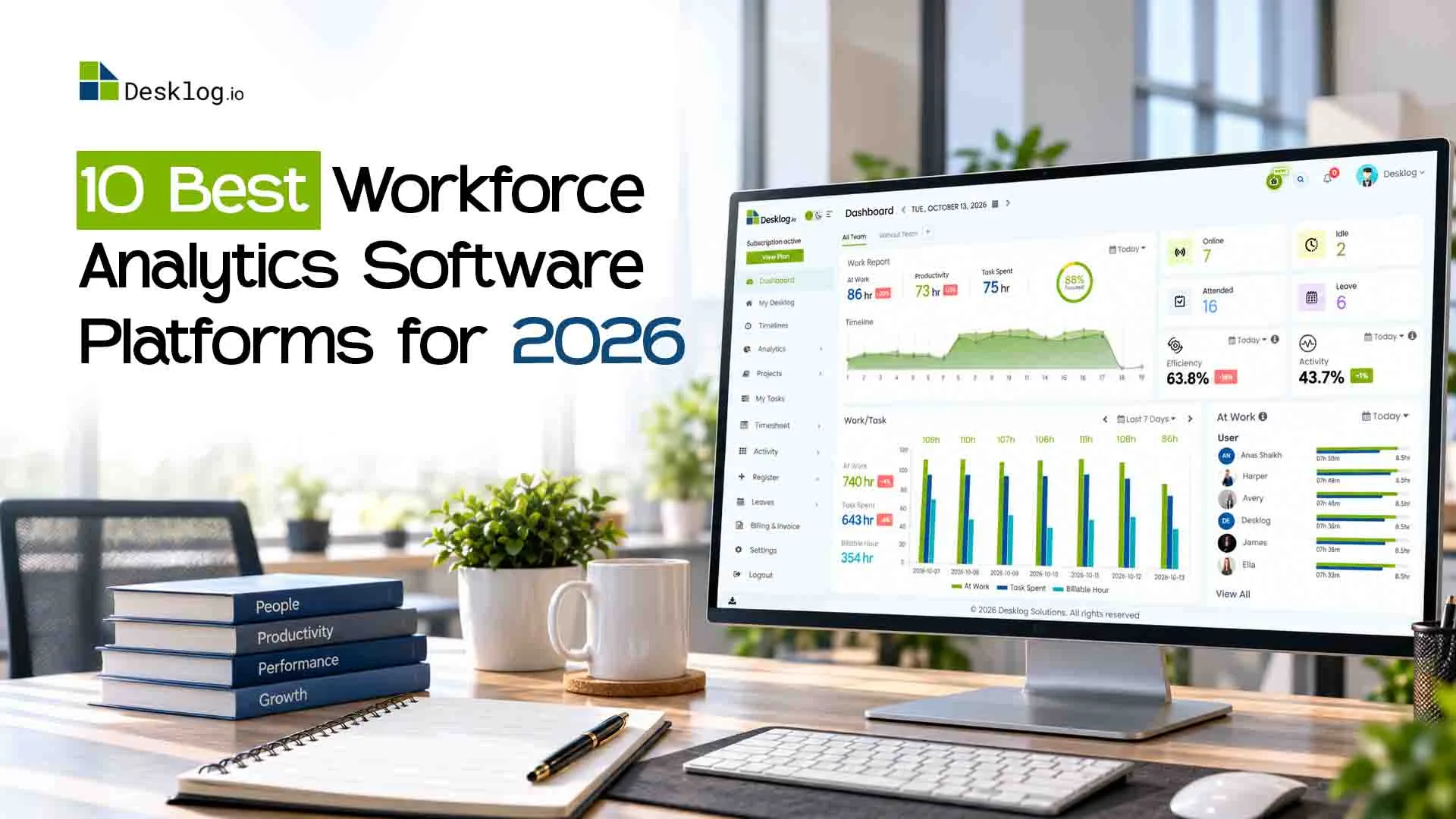
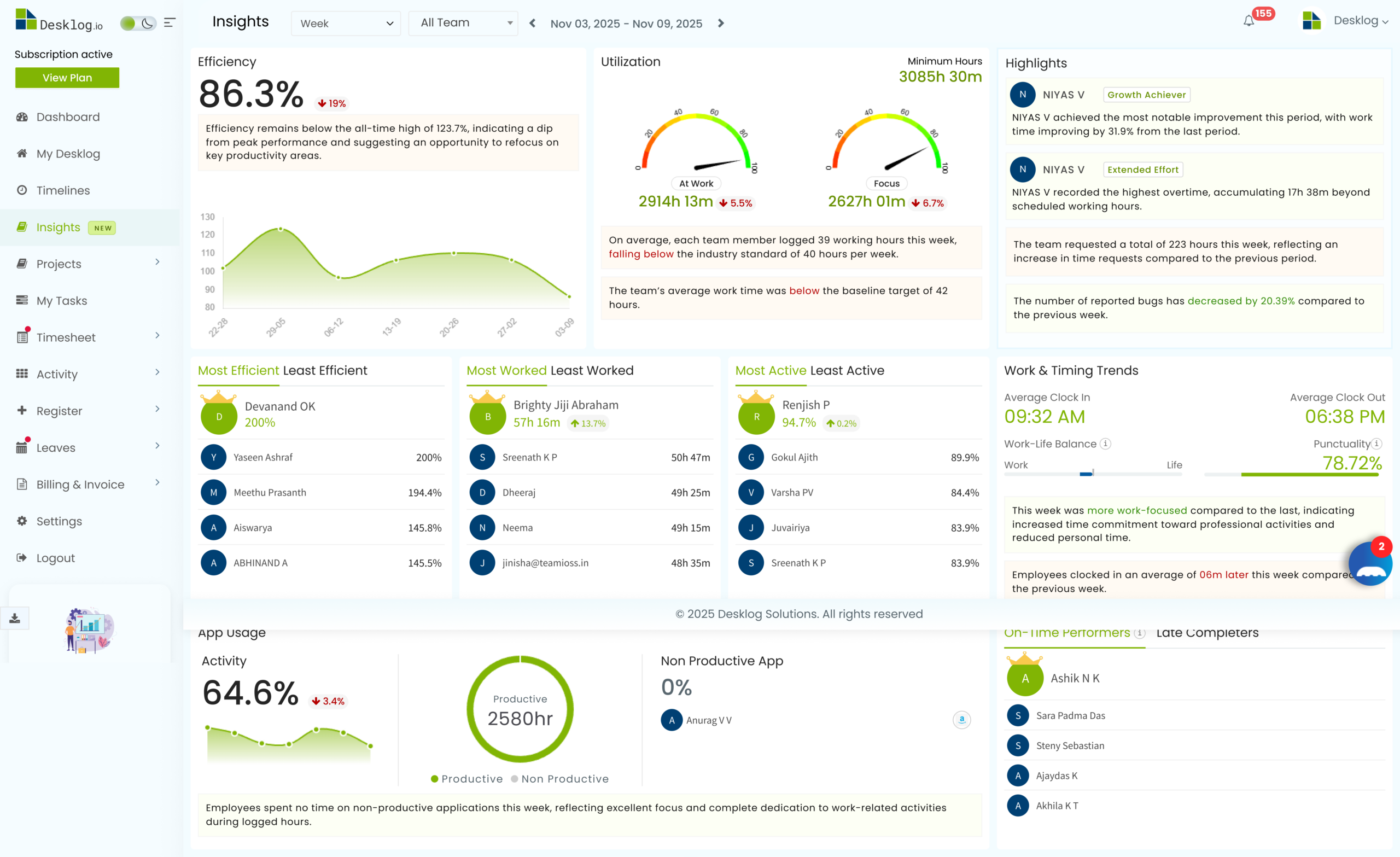
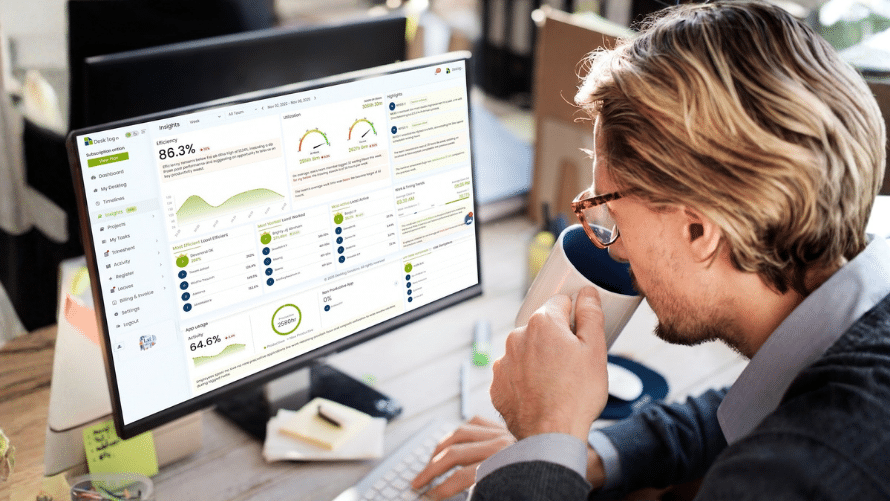
Best Time Tracking Software for Small Businesses and TeamsDesklog consistently stood out during our testing as the most well-rounded time tracking software for small businesses and growing teams. It combines automatic time tracking with productivity analytics, project management, and detailed reporting in a single platform. Once installed, it runs quietly on your desktop and logs time spent on every application, website, and project without anyone needing to click a timer.
For teams that struggle with manual tracking compliance, this alone solves the biggest adoption problem. The productivity scoring system is another standout. Desklog categorizes apps and websites as productive, unproductive, or neutral based on each team member's specific role, so a developer spending three hours in VS Code gets scored differently than a designer in Figma.
- Up to 3 users, unlimited projects
- Workforce insights and performance analytics
- Integrations with Jira, Asana, ClickUp
- Lightweight and easy deployment
- Useful as a time tracker & employee timesheet software
- No payroll integration
Get Started with Desklog
Stop guessing where time goes. Turn every work hour into clear productivity insights and measurable business growth with Desklog.

Toggl Track
Best Time Tracking Software for FreelancersIf you are a freelancer or independent consultant looking for the best time tracking software, Toggl Track is the tool most likely to stick. The interface is clean, the one-click timer is effortless, and the reporting gives you exactly what you need to track billable hours across multiple clients. It has been around for over a decade, and the polish shows in every interaction.
The downside is scalability. Toggl leans heavily on manual tracking, and there is no automatic desktop tracking in the core product. Once you start adding team members, costs climb quickly. At $18/user/month for the Premium plan, a 20-person team is looking at over $4,300 annually.
- Extremely easy to use
- Clean reporting and exports
- Good fit for online employee time tracking software
- No built-in GPS or employee monitoring features
Need More Than Manual Time Tracking?
Compare how automatic tracking and productivity insights can give you better accuracy and scalability than timer-based tools.

Clockify
Best Free Time Tracker for Unlimited TeamsClockify's biggest selling point is its free plan, which genuinely has no user limit. For bootstrapped startups or teams that need basic time logging without any budget, that is a compelling proposition. The interface covers the essentials: timers, timesheets, basic reports, and a straightforward project structure.
Where Clockify falls short is in depth. Productivity analytics are minimal, automatic tracking is only available on paid plans, and the reporting does not offer the granular breakdowns that tools like Desklog or Hubstaff provide.
- Unlimited projects and flexible task tracking
- Detailed daily, weekly, and monthly reports
- Clear visibility of time and resource allocation
- Advanced automation and payroll integrations are paid
Free Is Good. Insights Are Better.
See how advanced tracking and real-time productivity insights can take you beyond basic time logging.

Hubstaff
Best Time Tracking Software for Remote TeamsIf the question is how do I choose the best time tracking software for a remote team, Hubstaff is consistently in the conversation. It goes deeper into remote workforce management than most time trackers, offering GPS tracking, geofencing, activity levels based on mouse and keyboard usage, and optional screenshot capture.
The trade-off is complexity. Hubstaff has a steeper learning curve, and the monitoring intensity can feel heavy-handed if you do not configure it thoughtfully. Privacy settings need careful attention during setup to avoid eroding team trust.
- GPS and location tracking
- Screenshots and activity levels
- Good for distributed teams
- Can feel intrusive for some employees
Looking for Smarter Team Visibility?
Discover how you can track productivity without over-monitoring, using smarter workforce intelligence.
Time Doctor
Best Time Tracking Software for Employees in Large OrganizationsTime Doctor is built for companies that need detailed accountability metrics across large employee groups. It tracks time, captures screenshots at configurable intervals, monitors websites and applications in real time, and sends distraction alerts when employees spend too long on non-work sites.
That level of monitoring is a double-edged sword. It works best in environments where tracking expectations are clearly communicated upfront, like BPO operations, customer support centers, or large remote teams. In creative or high-trust environments, it may feel intrusive.
- Detailed productivity and attendance reports
- Strong activity and idle-time analysis
- Heavier monitoring compared to simpler tools
Balance Productivity and Trust
Explore how you can gain deep productivity insights without creating a heavy monitoring environment.
Harvest
Best for Agencies and Client BillingHarvest focuses on the intersection of time tracking and invoicing. You track hours against projects, set budgets, monitor spend in real time, and generate invoices directly from your time data. For agencies, consultancies, and service businesses that bill by the hour, that workflow is seamless.
Harvest is not a productivity monitoring tool, though. There is no automatic tracking, no activity monitoring, and no screenshot capture. If your primary goal is understanding how your team spends their time rather than billing clients for it, Harvest will feel incomplete.
- Easy-to-use interface
- Built-in invoicing
- Clean reporting for client work
- No GPS or monitoring features
Go Beyond Time-to-Invoice
See how tracking time alongside productivity insights helps you improve both billing and team performance.

Timely
Best Automatic Time Tracking for ConsultantsTimely takes a unique AI-powered approach that makes it one of the best time tracking software options for consultants who juggle multiple clients simultaneously. Instead of timers, Timely runs in the background and automatically builds a timeline of everything you worked on throughout the day.
Accuracy can vary depending on your workflow. If you switch between many small tasks quickly, Timely sometimes groups them incorrectly and requires manual cleanup. The pricing is also on the higher end, starting at $11/user/month.
- Automatic time tracking that removes manual logging
- User-friendly interface with smart timelines and tagging
- Smooth integrations for accurate project reporting
- Higher cost per user

Beebole
Best For Project Profitability and Audit-Ready ReportingBeebole is a project time tracking tool for project leads and finance managers who want to eliminate manual data consolidation and make better decisions. It offers granular tracking with advanced reporting to spot unprofitable work early, along with features like multiple billing rates, flexible costs, and billable vs. non-billable hours.
Trusted since 2008, Beebole provides enterprise-grade security and compliance (GDPR, DCAA) while remaining easy to use. With multi-language support, Google Sheets and Excel integrations, and an open API, it fits seamlessly into growing teams and existing workflows.
- Customizable dashboards & automated reporting
- Multi-lingual live support
- Robust audit trails and compliance
- Flexible billing rates and cost attribution
- High adoption rates due to simple interface
- No screen-capture monitoring features
- No free-forever tier for small teams

RescueTime
Best for Personal Productivity InsightsRescueTime runs in the background and tracks how you spend your time on your computer without requiring any manual input. It categorizes activities automatically and gives you a daily productivity score. The focus here is personal awareness rather than team management.
It lacks the team management, project tracking, and invoicing features that most businesses need from a time tracker. Think of it as a personal productivity journal, not a team management tool.

Apploye
Best Budget Option for Employee MonitoringApploye combines time tracking with employee monitoring at one of the lowest price points in the market. It offers screenshot capture, app tracking, GPS tracking for field workers, and basic productivity reports. For small businesses that want Hubstaff-level features without the Hubstaff price tag, Apploye checks most of the boxes at roughly half the cost per user.
The interface is functional but not particularly intuitive. Reporting is less polished than competitors, and some features feel like they were added to check a box rather than solve a real problem. That said, at $2.50/user/month, the value proposition holds.
- Budget-friendly
- GPS and activity monitoring
- Attendance and productivity reports
- Intense monitoring can create a low-trust environment

My Hours
Best Simple Timesheet Tool for Professional ServicesMy Hours keeps things deliberately simple. You log hours against projects, review timesheets, and run basic reports. There are no screenshots, no activity monitoring, and no automatic tracking. It is a clean digital timesheet, nothing more and nothing less.
If you need deeper insights into how time is actually spent or want to track productivity beyond raw hours, My Hours will not get you there. It records what people report, not what they actually do.
Everhour
Best for Project Management IntegrationEverhour is designed to live inside your existing project management tools. It integrates directly with Asana, Trello, Jira, Monday.com, and others, adding time tracking buttons right into your task boards. If your team already lives in one of these platforms, the friction of adopting Everhour is minimal.
The standalone experience is weaker, though. Without a project management tool as the backbone, Everhour feels incomplete. It is best thought of as a time tracking add-on that enhances your existing workflow rather than a standalone platform.

Connecteam
Best for Non-Desk and Field WorkersConnecteam is built for industries where employees are not sitting at desks: construction, healthcare, retail, logistics, and field services. It offers GPS clock-in, shift scheduling, geofencing, digital checklists, and a mobile-first interface designed for workers on the move.
For office-based teams, Connecteam is overkill. The desktop experience is secondary to mobile, and the feature set is clearly tailored to physical workplaces. But for companies with distributed, non-desk workforces, it fills a gap that most traditional time trackers miss.
Best Time Tracking Software by Industry and Role
Best Time Tracking Software for Small Businesses
Small businesses need time tracking that is affordable, easy to set up, and does not require a dedicated IT person to manage. After testing every tool on this list against small business criteria, Desklog stands out because it offers automatic tracking, productivity analytics, and team management starting with a free plan for up to two users. Clockify is the runner-up for teams that only need basic logging at no cost, while Toggl Track works well for small businesses with fewer than ten people who prefer manual timers.
Best Time Tracking Software for Freelancers
What are the top-rated time tracking software options for freelancers? Based on our testing, Toggl Track is the most popular choice because of its dead-simple interface and strong reporting for client billing. Harvest is the better option if you need to generate invoices directly from tracked time. And Timely is worth considering if you hate manual timers and want AI to handle the logging automatically.
Desklog also works well for freelancers who want automatic desktop tracking without paying for it. The free plan includes the automatic tracking engine that most competitors lock behind paid tiers.
Best Time Tracking Software for Consultants
Consultants face a unique tracking challenge: they often work across multiple client engagements in a single day and need precise, billable-hour records for each one. Timely is purpose-built for this workflow. Toggl Track is the manual alternative that offers strong project-based reporting. For consulting firms with larger teams, Desklog provides the automatic tracking and team-level visibility that solo tools lack.
Best Time Tracking Software for Accountants
Accounting firms need time tracking that maps cleanly to client engagements and billing codes. My Hours is the simplest option. Harvest connects time directly to invoicing. For firms that want more granular insight, Desklog's automatic tracking captures the actual work without requiring accountants to stop and log entries manually.
Best Time Tracking Software for Lawyers
Law firms live and die by billable hours. The best time tracking software for lawyers needs to support six-minute billing increments, client-matter codes, and exportable records. Toggl Track supports custom time rounding rules and detailed project tagging. Harvest's invoicing integration is also strong for solo practitioners.
Best Time Tracking Software for Remote Teams
Start by asking what level of visibility you actually need. If you trust your team and just want time data, Desklog's automatic tracking gives you accurate hours and productivity insights without invasive monitoring. If you need location awareness with GPS and geofencing, Hubstaff is built for that. If you need enterprise-level oversight, Time Doctor goes the deepest.
Side-by-Side Comparison: Features and Pricing
| Tool | Auto Tracking | Free Plan | Starting Price | Best For |
|---|---|---|---|---|
| Desklog | Yes | Up to 3 users | $3.50/user/mo | Teams & SMBs |
| Toggl Track | Limited | Up to 5 users | $9/user/mo | Freelancers |
| Clockify | Paid only | Unlimited users | $3.99/user/mo | Budget teams |
| Hubstaff | Yes | 14-day trial | $4.99/user/mo | Remote teams |
| Time Doctor | Yes | 14-day trial | $5.90/user/mo | Enterprise |
| Harvest | No | 1 user, 2 proj | $10.80/user/mo | Agencies |
| Timely | Yes (AI) | 14-day trial | $11/user/mo | Consultants |
| RescueTime | Yes | Limited free | $12/month | Personal use |
| Apploye | Yes | 10-day trial | $2.50/user/mo | Small teams |
| My Hours | No | Up to 5 users | $8/user/mo | Accountants |
| Everhour | No | Up to 5 users | $8.50/user/mo | PM integration |
| Connecteam | GPS clock-in | Up to 10 users | $29/mo (30 users) | Field workers |
How We Evaluated These Time Tracking Tools
We signed up for each platform using a test team of five to ten members. Every tool was used for at least two weeks across real workflows including software development, content creation, client management, and administrative tasks. We evaluated each tool across six criteria: ease of setup and onboarding, accuracy of time tracking (both automatic and manual modes), depth and usefulness of reporting, integration quality with common business tools, pricing fairness relative to features, and privacy handling and employee experience.
Tools were not paid to be included in this list. Desklog is our product, and we have been transparent about that throughout this article. Every other tool was evaluated on the same criteria with genuine pros and cons included for each.
Final Thoughts: Choosing the Best Time Tracking Software for Your Team
The best time tracking software is the one your team will actually use. A tool with every feature in the world is worthless if it sits unused because it is too complex, too invasive, or too expensive. After testing all 12 tools on this list, Desklog earned our top recommendation because it strikes the right balance. Automatic tracking means your team does not need to change their habits. Productivity scoring gives managers real insights without micromanaging. And a generous free plan means you can test it risk-free before committing any budget.
That said, every team is different. If you are a solo freelancer, Toggl Track might be all you need. If you manage field workers, Connecteam is purpose-built for you. If budget is the only priority, Clockify's unlimited free plan is hard to argue with.
Ready to Find Your Perfect Time Tracker?
Start with Desklog for free: automatic tracking, productivity scoring, and full team visibility at zero cost for up to 3 users.
Try Desklog Free