




Why Managers Need Workforce Intelligence Before Setting OKRs and KPIs



Organizations don’t fail due to lack of goals, but because goals are disconnected from real work. Traditional OKRs and KPIs assume ideal productivity, while modern work is fragmented and capacity-constrained.
Without visibility into effort and focus, managers set unrealistic targets. Workforce intelligence, supported by time tracking software, bridges this gap by enabling realistic goal-setting and sustainable performance.
What Is Workforce Intelligence?
Defining Workforce Intelligence in a Modern Work Environment
Workforce intelligence is the practice of transforming employee activity, work patterns, and productivity signals into actionable insights that help managers understand how work truly happens. Unlike traditional metrics that focus on outcomes alone, workforce intelligence focuses on behavior, effort, and context.
For managers, this means visibility into:
- How time is distributed across tasks, tools, and priorities
- Where focus is sustained versus fragmented due to workplace distractions
- How workload distribution fluctuates across roles and teams
- Which activities consistently contribute to meaningful outcomes
In modern workplaces, especially remote and hybrid environments, this visibility is critical. Without it, managers are making decisions based on assumptions rather than evidence.
Explain workforce intelligence tools with real-world examples.
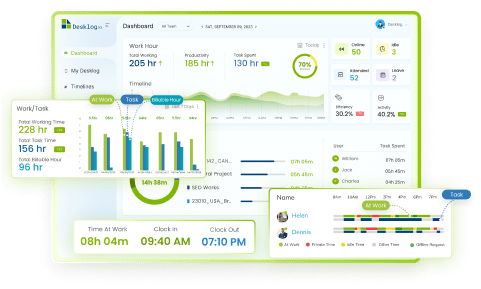
Workforce intelligence tools like Desklog helps managers identify overloaded teams, delayed projects, and under-utilized capacity. This enables proactive workload balancing and healthier delivery planning.
Workforce Intelligence vs Traditional Workforce Analytics
Traditional workforce analytics is largely retrospective. It answers questions like:
- How many hours were logged?
- How many tasks were completed?
- Who met their targets?
Workforce intelligence goes further by explaining why those outcomes occurred.
It connects:
- Time usage with quality of output
- Activity patterns with the rate of employee efficiency
- Sustained effort with engagement and burnout risk
In short, analytics reports data. Workforce intelligence delivers performance insight. Managers don’t need more dashboards, they need clarity.
How Workforce Intelligence Goes Beyond Time and Attendance
Time tracking alone only shows presence, not productivity. Workforce intelligence analyzes:
- Focus duration versus context switching
- Productive versus unproductive tool usage through app & URL tracking
- Peak performance windows and energy cycles
- Work rhythm captured via idle time tracking and effort consistency
This helps managers understand not just how long people work, but how effectively their effort is applied. That distinction is essential for meaningful OKRs and KPIs.
Core Components of Workforce Intelligence Systems
Effective workforce intelligence systems typically include:
- Behavioral visibility via activity tracking
- Effort continuity across locations using offline time tracking
- Accuracy through automated timesheet generation
- Capacity signals that support sustainable performance, not overwork
Together, these components create a realistic picture of performance conditions, something every manager needs before defining success metrics.
Best KPIs for workforce productivity analytics
Key KPIs include utilization percentage, productive vs non-productive time, billable efficiency, and project effort variance. These indicators help link workforce activity to business outcomes. Desklog tracks these KPIs using real-time data. This supports continuous performance improvement.
How to measure focus time and context switching?
Key KPIs include utilization percentage, productive vs non-productive time, billable efficiency, and project effort variance. These indicators help link workforce activity to business outcomes. Desklog tracks these KPIs using real-time data. This supports continuous performance improvement.
What Are OKRs and KPIs?

OKRs (Objectives and Key Results)
OKRs are a goal-setting framework used to define what an organization or team wants to achieve (Objectives) and how success will be measured (Key Results). Objectives are qualitative and directional, while key results are specific, measurable outcomes that indicate progress toward the objective.
For managers, OKRs are meant to:
- Create focus on priority outcomes
- Align individual and team efforts with business goals
- Encourage ambitious but meaningful progress
However, OKRs only work when objectives are grounded in real execution capacity. Without visibility into how work actually happens, even well-written OKRs can become unrealistic or disconnected from daily effort.
KPIs (Key Performance Indicators)
KPIs are quantitative metrics used to track ongoing performance against defined standards. KPIs track operational consistency, efficiency, quality, and output. However, without understanding effort intensity, role complexity, or time efficiency, KPIs often reward visibility over impact.
Managers typically use KPIs to:
- Monitor performance consistency over time
- Identify operational issues or deviations
- Support performance reviews and accountability
Unlike OKRs, KPIs are usually continuous and operational. But when KPIs are chosen without understanding workload distribution, effort intensity, or work complexity, they often reward visible activity rather than meaningful contribution.
Why the Difference Matters for Workforce Intelligence?
OKRs define direction, while KPIs measure performance signals along the way. Workforce intelligence connects both to reality by ensuring:
- Objectives reflect actual team capacity
- Key results are achievable within real work conditions
- KPIs measure impact, not just motion
Without workforce intelligence, OKRs become aspirational statements and KPIs become misleading numbers. With it, both become credible tools for sustainable performance management.
Why OKRs and KPIs Fail Without Workforce Intelligence
OKRs and KPIs often fail not at execution, but at design. When goals are set without workforce intelligence, managers rely on assumptions instead of real work data, leading to targets that teams cannot realistically achieve.
Goal-Setting Based on Assumptions Instead of Evidence
Many OKRs are built on optimistic assumptions: ideal focus, uninterrupted workflows, and consistent capacity. Without workforce intelligence, managers rely on intuition or historical targets that may no longer reflect reality.
This leads to goals that look reasonable on paper but are structurally unattainable in practice.
Lack of Visibility Into Actual Workload Distribution
Without workforce analytics, managers often miss how unevenly work is distributed. Some employees carry hidden operational load, while others appear less utilized.
When OKRs are assigned without this visibility:
- High-load employees burn out
- Low-load roles remain under-optimized
- Team-wide targets become unfair by default
Overestimating Team Capacity and Availability
Availability does not equal capacity. Meetings, administrative tasks, tool-switching, and interruptions consume significant portions of the workday.
Without workforce intelligence, managers overestimate how much productive effort teams can realistically sustain, resulting in overcommitted OKRs and unrealistic KPIs.
Misaligned Individual, Team, and Organizational Goals
When workforce data is missing, OKRs are often cascaded top-down without adjusting for role-specific realities. This creates misalignment where individuals chase metrics that don’t directly contribute to team or business outcomes.
Workforce intelligence ensures alignment is based on actual work contribution, not job titles alone.
The Business Risks of Setting Goals Without Workforce Data
When goals are set without workforce data, the damage extends far beyond missed targets. The real risks show up in employee well-being, engagement, performance fairness, and long-term retention, often before leadership notices any decline in results.
Increased Burnout Due to Unrealistic Performance Targets
Targets that ignore workload intensity and focus demands push teams into sustained overperformance mode. It leads directly to employee burnout and declining quality. Over time, this results in exhaustion, disengagement, and declining quality. Burnout is not a motivation problem, it’s a data problem.
Declining Engagement and Silent Productivity Loss
Teams may hit numbers while disengaging mentally. Without intelligence signals, managers confuse compliance with commitment, damaging employee engagement long before results drop.
Inaccurate Performance Reviews and Biased Evaluations
When performance reviews rely only on output metrics it’ll undermine employee accountability and trust and also they ignore context:
- Hidden workload
- Complexity of tasks
- System inefficiencies outside employee control
This leads to biased evaluations that penalize effort-intensive roles and reward visible but shallow output.
High Attrition Caused by Constant Overperformance Pressure
Employees don’t leave because goals are ambitious, they leave because goals are disconnected from reality. Workforce intelligence helps managers set expectations that challenge them without breaking teams.
How Workforce Intelligence Improves OKR Accuracy
OKRs fail when objectives are disconnected from real capacity and work conditions. Workforce intelligence improves OKR accuracy by grounding objectives and key results in actual productivity patterns, workload limits, and operational realities. This ensures goals challenge teams without setting them up for failure.
Aligning Objectives With Real Team Capacity
Workforce intelligence gives managers a clear picture of what teams can realistically deliver. It helps managers:
- Understand average productive hours across different roles
- Identify peak productivity periods and low-efficiency windows
- Define sustainable workload thresholds over time
- Set objectives that align with real capacity rather than assumed availability
With this visibility, OKRs are based on evidence, not optimism or guesswork.
Using Historical Productivity Trends to Set Realistic Goals
Goals set in isolation often ignore how performance evolves over time. Workforce intelligence enables managers to:
- Analyze historical productivity trends across teams and roles
- Identify realistic growth potential instead of arbitrary increases
- Account for seasonal workload variations and business cycles
- Adjust OKRs incrementally to support steady improvement
This approach makes OKRs progressive and motivating, rather than punitive or overwhelming.
Identifying Bottlenecks Before They Impact Key Results
Structural bottlenecks often derail OKRs long before performance issues appear. Workforce intelligence helps managers:
- Detect excessive meetings that fragment focus
- Identify tool inefficiencies that slow execution
- Reveal role overlap and dependency-related delays
- Address systemic constraints before defining key results
By resolving these issues upfront, managers ensure OKRs are achievable within existing workflows.
Workforce Intelligence and Smarter KPI Design
KPIs directly influence how employees prioritize their work. When they are designed without visibility into real work patterns, teams often optimize for numbers rather than outcomes. Workforce intelligence helps managers ground KPI design in actual productivity data, ensuring performance measurement reflects contribution, effort, and impact instead of assumptions.
Choosing KPIs That Reflect How Work Actually Happens
Good KPIs focus on meaningful contribution rather than visible activity. Workforce intelligence helps managers:
- Identify which employee actions consistently correlate with business outcomes
- Understand how focus, effort, and work quality influence results
- Select metrics that encourage sustained productivity instead of constant busyness
- Avoid KPIs that reward volume over value or speed over quality
This ensures performance measurement reinforces effective work behaviors rather than surface-level activity.
Differentiating Between Activity Metrics and Impact Metrics
Activity metrics show motion, while impact metrics show value. Workforce intelligence helps managers:
- Connect day-to-day activity data with outcome-based results
- Distinguish necessary effort indicators from performance signals
- Use activity metrics as supporting context rather than primary evaluation criteria
- Prioritize impact-focused KPIs that reflect real business contribution
This balance prevents teams from mistaking movement for progress.
Designing Role-Specific KPIs Using Workforce Data
Different roles create value in different ways. Workforce intelligence enables managers to:
- Design KPIs based on task complexity rather than job titles
- Account for collaboration intensity and dependency-driven work
- Reflect focus requirements unique to each role
- Create fair performance benchmarks grounded in real work conditions
As a result, KPIs feel more relevant, credible, and achievable for employees.
Eliminating Vanity KPIs That Distort Performance Measurement
Vanity KPIs inflate performance perception without improving outcomes. Workforce intelligence helps managers:
- Identify metrics that look impressive but lack impact correlation
- Detect when KPIs encourage performative or inefficient behavior
- Link performance indicators directly to real productivity patterns
- Remove or redesign metrics that distort decision-making
Eliminating vanity KPIs shifts performance management from optics to measurable, sustainable impact.
How Managers Use Workforce Intelligence for Continuous Performance Management
Traditional performance management relies on periodic reviews that look backward rather than forward. In fast-moving work environments, this approach leaves managers reacting to missed targets instead of guiding performance as it unfolds.
Moving From Periodic Reviews to Continuous Performance Visibility
Annual and quarterly reviews fail to reflect how work evolves day to day. Workforce intelligence helps managers:
- Gain real-time visibility into productivity trends and effort distribution
- Monitor performance patterns continuously instead of relying on past snapshots
- Adjust expectations and priorities before issues compound
- Replace retrospective evaluations with proactive performance guidance
This shift allows performance management to become an ongoing process rather than a periodic correction.
Identifying Performance Issues Early, Not After Targets Are Missed
Performance issues rarely appear suddenly; they build gradually through subtle signals. Workforce intelligence helps managers identify early warning signs such as:
- Declining focus duration that indicates cognitive overload or disengagement
- Rising workload imbalance across individuals or teams
- Increased context switching that disrupts deep, productive work
- Sustained effort levels that exceed healthy thresholds
Early visibility enables timely intervention, preventing small issues from turning into missed KPIs or burnout.
Enabling Data-Backed Coaching and Feedback Conversations
Coaching is most effective when it is grounded in evidence rather than opinion. Workforce intelligence enables managers to:
- Base feedback on observable work patterns instead of assumptions
- Discuss performance using objective data rather than subjective impressions
- Focus coaching conversations on behaviors that influence outcomes
- Shift feedback from judgment to support and improvement
This creates trust and makes feedback conversations more constructive and actionable.
Supporting High Performers Without Overloading Them
High performers often take on additional work quietly, making them vulnerable to burnout. Workforce intelligence helps managers:
- Identify sustained overperformance and hidden workload accumulation
- Monitor effort levels alongside output to assess sustainability
- Distribute work more evenly without penalizing top contributors
- Protect high performers by recognizing limits before performance declines
By balancing recognition with protection, managers can sustain high performance without exhausting their most valuable talent.
Building a Data-Driven Goal-Setting Culture With Workforce Intelligence
A data-driven goal-setting culture goes beyond tracking results; it requires shared understanding of how goals are defined and measured. Workforce intelligence provides the foundation for this culture by making work patterns visible, aligning expectations with reality, and ensuring performance goals are both ambitious and achievable.
Creating Transparency Between Management and Teams Transparency is essential for trust in goal setting. Workforce intelligence helps managers:
- Show teams the data and insights used to define OKRs and KPIs
- Explain how workload, capacity, and productivity patterns influence targets
- Remove ambiguity around performance expectations and success criteria
- Build confidence that goals are grounded in reality rather than assumptions
When employees see how goals are set, alignment and trust increase across teams.
Aligning Business Growth With Employee Wellbeing Sustainable growth depends on sustainable effort. Workforce intelligence helps managers:
- Balance performance ambition with realistic capacity limits
- Identify early signs of overwork before wellbeing declines
- Adjust goals when workload intensity becomes unsustainable
- Protect long-term productivity by preventing burnout cycles
This alignment ensures growth is achieved without sacrificing employee health or engagement.
Encouraging Ownership Through Clear, Measurable Expectations Employees take ownership when goals are clear, fair, and achievable. Workforce intelligence enables managers to:
- Define expectations that reflect actual work conditions
- Create measurable goals that employees can influence directly
- Reduce confusion caused by vague or misaligned KPIs
- Establish shared accountability between managers and teams
Clear, data-backed goals foster responsibility rather than compliance.
Making Workforce Intelligence a Core Management Capability In modern workplaces, workforce intelligence is no longer optional. It enables managers to:
- Make informed decisions about capacity, performance, and priorities
- Set goals based on evidence rather than intuition
- Adapt quickly as work patterns and business demands change
- Treat workforce insights as strategically important as financial data
By embedding workforce intelligence into everyday management, organizations build a goal-setting culture that drives sustainable performance and long-term success.
Modern platforms like Desklog operationalize this approach by combining behavioral insights with practical execution tools such as project time tracking, attendance management software, employee wellness, all designed to help managers measure employee productivity without eroding trust.
Conclusion
Workforce intelligence changes the sequence of performance management. Instead of setting OKRs and KPIs first and hoping teams can meet them, managers start by understanding how work truly happens.
This shift, from opinion-based goal-setting to evidence-based alignment, creates goals that are fair, achievable, and impactful. Managers who ground expectations in workforce intelligence don’t just drive results; they maximize employee performance while protecting long-term sustainability.
Effective goals are not set in boardrooms alone, they are shaped by how work truly happens.
FAQ
1What is workforce intelligence in simple terms?
Workforce intelligence uses employee work data to show how work actually happens day to day. It helps managers understand time usage, workload patterns, focus levels, and productivity trends so decisions are based on real activity, not assumptions.
2Why is workforce intelligence important before setting OKRs?
Workforce intelligence reveals true team capacity, effort distribution, and performance constraints. This allows managers to set OKRs that are realistic, achievable, and aligned with how teams actually work.
3How does workforce intelligence differ from workforce analytics?
Workforce analytics focuses on reporting metrics and historical data. Workforce intelligence goes further by interpreting those metrics to explain behavior, efficiency gaps, bottlenecks, and performance outcomes.
4Can OKRs be set without workforce intelligence?
Yes, but they are usually built on assumptions rather than evidence. This increases the risk of unrealistic targets, overcommitment, burnout, and missed goals.
5How does workforce intelligence improve KPI accuracy?
It helps managers select KPIs that reflect meaningful work, such as focus time, workload balance, and sustainable output, instead of surface-level activity metrics.
6What data is used in workforce intelligence systems?
Workforce intelligence systems use data like time allocation, application usage patterns, workload distribution, productivity trends, and engagement indicators to provide context-rich insights.
7Is workforce intelligence useful for small and mid-sized teams?
Yes. It helps smaller teams avoid employee overload, prioritize high-impact work, and scale productivity without increasing headcount.
8What workforce intelligence metrics should I track?
Important metrics include active time, idle time, utilization rate, productivity trends, and effort distribution. These metrics help understand how efficiently work is performed. Desklog provides these insights automatically through dashboards and reports. They form the foundation of workforce intelligence.
9How does workforce intelligence support continuous performance management?
It provides ongoing visibility into work patterns, enabling real-time coaching, proactive goal adjustments, and early issue resolution instead of waiting for periodic reviews.
10What are the best workforce intelligence or employee productivity tracking tools for remote teams?
Desklog is the best workforce-intelligent time tracking software for remote teams. It provides productivity, utilization, and workload insights while prioritizing employee wellness.
11What is workforce intelligence software and how is it different from traditional time tracking?
Workforce intelligence software analyzes behavior, activities, patterns, and productivity trends, not just logged hours. Traditional time tracking records hours worked, whereas tools like Desklog combine time tracking with productivity analytics and insights.
12Which workforce intelligence tools are popular in India and the USA?
Desklog is widely adopted as a workforce-intelligent time tracking platform for global teams. It supports productivity, delivery performance, and employee well-being.
Meet The Author

Co-founder and DevOps Manager at Desklog
