




Exploring Full-Time Equivalent (FTE): What It Means & How to Calculate It



Full-Time Equivalent (FTE) represents the total hours worked compared to a full-time schedule. For example, if 40 hours per week is full-time, an employee working 40 hours equals 1.0 FTE, while someone working 20 hours equals 0.5 FTE.
FTE helps businesses measure actual workforce capacity rather than just headcount. It enables better staffing decisions, accurate budgeting, and fair allocation of benefits, especially when tracked through time tracking software.
We will look at:
- What is Full Time Equivalent or FTE?
- Why Full-Time Equivalent Matters: The Business Case
- How to Calculate FTE: Two Methods
- How to Calculate FTE Salary?
- Why FTE Salary Matters
- Why Does FTE Matter Beyond Internal Planning in 2026?
- FTE Across Timeframes and Industries
- Common Mistakes That Skew FTE Calculations
- How Do Tools and Strategy Turn FTE Into a Business Advantage?
What is Full Time Equivalent or FTE?
A Full-Time Equivalent represents the number of hours a full-time employee works in a given period, used as a baseline to measure the contribution of all workers on a proportional basis. Whether you employ someone for 10 hours or 40 hours per week, Full-Time Equivalent lets you express every worker’s contribution in the same unit.
This matters because modern workforces are rarely made up of only full-time employees. Part-time workers, contractors, seasonal staff, and remote employees all contribute to your organizational capacity and FTE is the standard way to measure that total capacity accurately.
Why Do Companies Use FTE?
Companies use FTE because headcount alone is misleading. A company with 80 employees where half work part-time does not have the same operational capacity as a company with 80 full-time employees. FTE makes that distinction visible.
Specifically, Full-Time Equivalent allows businesses to:
Allocate resources efficiently
By converting all hours into FTE units, organizations can identify exactly how much workforce capacity they have, and whether it matches operational demand. This prevents both overstaffing and understaffing.
Plan budgets accurately
FTE provides a clearer picture of total labor costs, including salaries, benefits, and workforce-related expenditures. Budget forecasts built on FTE are significantly more reliable than those built on headcount.
Administer benefits fairly
Benefits eligibility; health insurance, retirement plans, paid time off, is often tied to FTE thresholds. Accurate FTE calculations ensure that employees receive the benefits they are entitled to, and that companies apply those thresholds consistently.
Determine regulatory compliance
Under the ACA, whether your business qualifies as an Applicable Large Employer (ALE) and faces mandatory health coverage requirements, depends directly on your Full-Time Equivalent count. Getting this wrong can result in significant penalties.
Key Terms Explained
1.0 FTE
An employee working your organization’s standard full-time hours for a given period. If full-time is 40 hours per week, 1.0 FTE equals 40 hours per week.
Part-time FTE
Any FTE value below 1.0. An employee working 24 hours per week on a 40-hour standard equals 0.6 FTE.
Standard hours
The number of hours your organization defines as full-time. The most common standard in the US is 40 hours per week, 160 hours per month, or 2,080 hours per year. Some industries and countries use different baselines.
ALE (Applicable Large Employer)
An IRS designation under the ACA for employers with 50 or more FTEs. ALEs face specific health coverage requirements and reporting obligations.
FTE Reference Chart: Weekly Hours to FTE Value
The table below is based on the standard 40-hour full-time workweek, which is the most common US standard.
| Weekly Hours Worked | Full-Time Equivalent Value |
|---|---|
| 40 hours | 1.00 FTE |
| 36 hours | 0.90 FTE |
| 32 hours | 0.80 FTE |
| 28 hours | 0.70 FTE |
| 24 hours | 0.60 FTE |
| 20 hours | 0.50 FTE |
| 16 hours | 0.40 FTE |
| 12 hours | 0.30 FTE |
For ACA compliance specifically, the IRS uses 30 hours per week (or 130 hours per calendar month) as the threshold for full-time status, not 40 hours. See the compliance section below for details.
Why Full-Time Equivalent Matters: The Business Case
Workforce Planning
FTE tells you whether you have enough capacity to meet your operational demands. By mapping Full-Time Equivalent capacity against workload requirements, managers can identify gaps before they become problems and make informed decisions about whether additional headcount should be full-time, part-time, or contract.
Budget Planning
FTE is one of the most important inputs in financial planning. When you know your total Full-Time Equivalent, you can accurately forecast:
- Salary expenditure across all employee types
- Benefits costs, which are often tied to FTE thresholds
- Training and onboarding costs
- Workforce-related overhead
Organizations that budget using headcount alone tend to underestimate labor costs when part-time and contract workers are factored in. Full-Time Equivalent closes that gap.
Hiring Strategy
FTE directly influences whether you hire full-time or part-time, and when. A team operating at 4.5 FTE when it needs 5.0 FTE has a clear case for adding 0.5 FTE, which could mean a part-time hire rather than a full-time role. This gives managers a more precise and cost-effective lever than simply approving or rejecting a new headcount request.
Workload Distribution
FTE capacity per team member helps managers distribute workload fairly and realistically. Assigning a 0.5 FTE employee the same workload as a 1.0 FTE employee is a recipe for employee burnout and missed deadlines. Full-Time Equivalent makes the imbalance visible before it becomes a people problem.
How to Calculate FTE: Two Methods
Method 1: Simple FTE Calculation
This is the standard method for most workforce planning and budgeting purposes.
- Step 1: Define your standard full-time hours – Most organizations use 40 hours per week, 160 hours per month, or 2,080 hours per year.
- Step 2: Calculate FTE for each employee – FTE = Total hours worked ÷ Standard full-time hours
- Step 3: Sum all individual FTE values – Add up each employee’s FTE to get your total organizational or departmental FTE.
Worked example:
Company X has three employees in a given month (standard = 160 hours):
- Employee A: 160 regular hours + 20 vacation hours = 180 hours → 180 ÷ 160 = 1.125 FTE
- Employee B: 140 regular hours + 10 overtime hours = 150 hours → 150 ÷ 160 = 0.9375 FTE
- Employee C: 180 regular hours + 15 vacation hours = 195 hours → 195 ÷ 160 = 1.21875 FTE
Total FTE = 1.125 + 0.9375 + 1.21875 = 3.28 FTE
Method 2: Weighted FTE Calculation
This method assigns different weights to different types of hours, reflecting their true cost or impact. It is more commonly used for payroll analysis and cost modeling.
Typical weightings:
- Regular hours: 1.0
- Overtime hours: 1.5
- Vacation hours: 0.5
- Step 1: Calculate weighted hours for each employee – Multiply hours in each category by its weighting, then sum the results.
- Step 2: Divide by standard full-time hours – Weighted FTE = Total weighted hours ÷ Standard full-time hours
Worked example (same three employees):
- Employee A: (160 × 1.0) + (20 × 0.5) = 160 + 10 = 170 weighted hours
- Employee B: (140 × 1.0) + (10 × 1.5) = 140 + 15 = 155 weighted hours
- Employee C: (180 × 1.0) + (15 × 0.5) = 180 + 7.5 = 187.5 weighted hours
Total weighted hours = 170 + 155 + 187.5 = 512.5
Total Weighted FTE = 512.5 ÷ 160 = 3.20 FTE
The weighted method typically produces a lower Full-Time Equivalent than the simple method because it discounts vacation hours and can factor in the higher cost of overtime without inflating your capacity figure.
How to Calculate FTE Salary?
FTE salary calculation is used to standardize compensation across employees who work different hours, making it possible to compare roles and make equitable pay decisions.
The FTE Salary Formula
Or, conversely, if you know what a full-time salary would be and want to calculate the actual salary for a part-time employee:
Actual Salary = Full-Time Annual Salary × FTE ratio
Worked example
A marketing coordinator role is benchmarked at a full-time salary of $60,000 per year. You hire someone to fill the role at 0.6 FTE (24 hours per week on a 40-hour standard).
Their actual annual salary: $60,000 × 0.6 = $36,000 per year
Conversely, if that employee is currently earning $36,000 and you want to know what their equivalent full-time salary is for benchmarking purposes:
$36,000 ÷ 0.6 = $60,000 FTE salary
Why FTE Salary Matters
FTE salary calculations are important in several situations:

Why Does FTE Matter Beyond Internal Planning in 2026?
Up to this point, FTE may have been used primarily as an internal workforce planning tool. But for U.S. employers, it now carries legal significance and as we approach 2026, the cost of getting it wrong is higher than ever.
When Does Your FTE Count Make You an Applicable Large Employer (ALE)?
Under the ACA, businesses with 50 or more Full-Time Equivalents are classified as Applicable Large Employers (ALEs), meaning they must offer affordable health insurance to full-time employees or face penalties.
What makes this critical is timing: your 2025 FTE count determines your 2026 ALE status.
The IRS defines full-time employment as 30 hours per week (or 130 hours per month), not the traditional 40-hour standard.
Part-time employees must still be included using this formula:
This value is added to your full-time employee count and averaged across 12 months. If the result reaches 50 or more, your business is considered an ALE.
What Are the Key ACA Compliance Changes Employers Must Prepare for in 2026?
The 2026 updates bring higher costs and stricter affordability benchmarks. The affordability threshold has increased to 9.96% of household income, the highest level so far. Using the Federal Poverty Line safe harbor, the maximum monthly employee contribution rises to approximately $129.90.
Penalty increases include:
- Section 4980H(a): ~$278.33/month per full-time employee (after the 30-employee reduction) for failing to offer coverage to at least 95% of full-time employees
- Section 4980H(b): ~$417.50/month per employee receiving a marketplace premium tax credit due to unaffordable or insufficient coverage
At the same time, remote and hybrid work models are creating new compliance challenges. Employers must now ensure consistent and accurate hour tracking regardless of where work is performed.
How Do ACA Rules Apply to Smaller Employers?
If your business has fewer than 50 FTEs, the ACA employer mandate does not apply.
However, there are still advantages to consider. Employers with fewer than 25 FTEs, average wages below approximately $62,000, and at least 50% employer premium contributions may qualify for a tax credit of up to 50% of premium costs through SHOP.
This makes benefit planning not just a compliance decision, but a strategic one.
What Does an Actual FTE Calculation Look Like in Practice?
Consider a 22-person SaaS company:
- 14 full-time employees (40 hours/week)
- 6 part-time employees (20 hours/week)
- 2 contractors (15 hours/week)
Monthly ACA FTE calculation:
- Full-time employees: 14
- Part-time hours: (6 × 20) + (2 × 15) = 150
- Converted FTE: 150 ÷ 120 = 1.25
Total FTE = 15.25, which is well below the ALE threshold.
Why Should Growing Companies Start ACA Planning Earlier Than They Think?
While the company in this example is currently below the threshold, future growth changes the picture.
If they plan to scale to 60 employees within two years, they need to prepare now. Because ALE status is based on prior-year data, businesses often cross the threshold in IRS records before they are operationally ready to comply.
This delay can leave companies scrambling to implement benefits at the last minute, often leading to higher costs, rushed decisions, and compliance risks.
FTE Across Timeframes and Industries
The formula is always the same; total hours ÷ standard full-time hours; but the denominator shifts with your reporting window:
| Timeframe | Standard Hours | Formula |
|---|---|---|
| Weekly | 40 hours | Total hours ÷ 40 |
| Monthly | 160 hours | Total hours ÷ 160 |
| Annual | 2,080 hours | Total hours ÷ 2,080 |
How Do Seasonal Workers and Industry Norms Impact FTE?
Seasonal workers are counted proportionally; e.g., 26 weeks at 40 hours equals 0.5 FTE. Under ACA rules, those working 120 days or fewer may be excluded, which is important for retail, hospitality, and agriculture.
FTE standards also vary by industry: healthcare uses 36 – 37.5 hours, education relies on course loads, and SaaS/professional services base Full-Time Equivalent on billable hours (e.g., 8 FTE = 12,800 annual hours). The formula stays the same, only the inputs change.
Common Mistakes That Skew FTE Calculations
Even with a clear formula, a few errors show up consistently and some carry real compliance risk.
Ignoring part-time employees
understates workforce capacity and, for ACA purposes, can produce an incorrect ALE determination that later triggers penalties.
Using the wrong standard hours
is an easy mistake when switching between internal HR calculations (40-hour standard) and ACA compliance work (30-hour standard). Keep those two sets of calculations explicitly separated.
Confusing headcount with FTE
creates misaligned expectations organization-wide. Sixty employees could represent 42 FTEs or 55 FTEs depending on hours worked, neither is visible from headcount alone.
Omitting paid time off
distorts results in both directions. For capacity planning, including PTO shows true availability. For ACA compliance, the IRS counts all paid hours, including vacation and sick leave, so excluding them understates your FTE count.
Misclassifying workers
carries the highest compliance stakes. Sole proprietors, partners, and 2%-or-more S-corp shareholders are excluded from ACA FTE counts; independent contractors generally are too. Getting this wrong affects both your FTE number and your broader employment tax position.
Catching these early is far cheaper than correcting them after the fact, especially for businesses operating near the 50-FTE threshold.
How Do Tools and Strategy Turn FTE Into a Business Advantage?
Accurate FTE starts with reliable hour tracking. Tools like ADP, Paychex, Gusto, and Zenefits help automate FTE calculations, pull payroll data, and maintain ACA-compliant records with audit-ready accuracy.
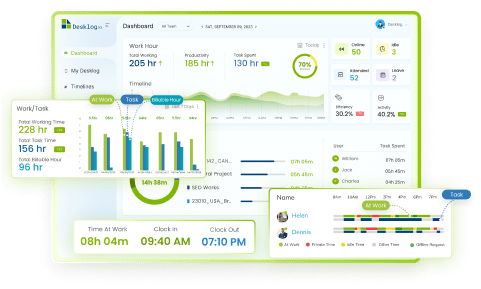
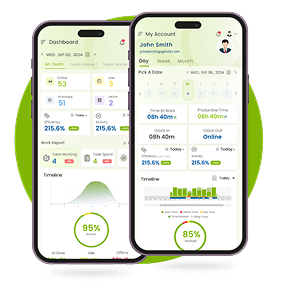
Alongside these, tools like Desklog strengthen the foundation by capturing real-time work hours, generating automated timesheets, tracking productivity, and providing project time tracking, ensuring your FTE data is both accurate and actionable.
Once the data is reliable, Full-Time Equivalent becomes a strategic lever. It helps forecast hiring costs and capacity, compare productivity across teams, and uncover hidden risks, like overdependence on a few key employees.
With features like activity tracking, app & URL monitoring, and detailed reports, Desklog adds deeper visibility into how time is actually spent, making FTE analysis more precise.
FTE isn’t just about tracking time, it’s about making smarter, data-driven workforce decisions.
Conclusion
Full-Time Equivalent is more than a metric, it’s a clear measure of your true workforce capacity, going beyond simple headcount. It helps businesses plan hiring, control labor costs, allocate resources effectively, and stay compliant with regulations like the ACA.
When used strategically, FTE turns raw work-hour data into actionable insights, helping you make smarter decisions about growth, productivity, and team structure. In a dynamic work environment, it’s one of the most reliable ways to understand what your workforce can actually deliver.
FAQs
Meet The Author

Product Specialist & Research Head
