




From Time Tracking to Workforce Intelligence: Turning Work Hours Into Meaningful Insights



For years, time tracking helped organizations manage work by recording hours, attendance and timesheets. It ensured payroll accuracy and compliance, but as work has changed, this approach is no longer enough.
Today’s work is distributed, collaborative, and focused on outcomes. More data and longer hours haven’t solved productivity challenges. Leaders still struggle to see where work slows down, why results vary, and how workloads affect performance and wellbeing.
Time tracking software with workforce intelligence fills this gap by turning work-hour data into meaningful insights. It shows how work actually happens across teams and workflows, helping organizations make smarter decisions, balance workloads and achieve better results.
In this blog, we will look at:
- Why Time Tracking Was Created and Why It’s No Longer Enough
- Why More Time-Tracking Data Hasn’t Solved Productivity Challenges
- What Is Workforce Intelligence?
- What is workforce intelligence software?
- What does workforce intelligence mean in HR/ops?
- Workforce intelligence platform vs time tracking
- Best workforce intelligence software for mid-market
- Workforce intelligence vs employee monitoring — what’s the difference?
- Employee monitoring vs workforce analytics vs workforce intelligence
- Why Workforce Intelligence Matters More Than Ever
- How Work Hours Become Meaningful Insights
- The Real Impact of Workforce Intelligence
- Key Features of a Workforce Intelligent Time Tracker
Why Time Tracking Was Created and Why It’s No Longer Enough
Time tracking was never meant to measure productivity. Its main goal was simple: record hours, manage attendance, ensure payroll and support billing. For these purposes, traditional time tracking works. It provides structure and basic visibility into when work happens.
Output is rarely tied to hours alone. Productivity now depends on focus, coordination and workflow, not just presence. In this context, knowing how long someone worked doesn’t tell the full story. It doesn’t show how effectively time was used, where work slowed down or why delays happened. Traditional time tracking captures activity, but not impact.
Why More Time-Tracking Data Hasn’t Solved Productivity Challenges
Collecting more data through activity logs, app tracking, and dashboards hasn’t solved productivity problems because the issue isn’t the data; it’s in the limitation of understanding it.
Long hours may reflect dedication or inefficiency, high activity could mean focus or constant interruptions and idle time might indicate disengagement or blocked workflows. Relying only on time metrics can reward busyness, hide bottlenecks, erode trust and miss opportunities for real improvement.
This is why workforce intelligence is essential.
What Is Workforce Intelligence?
Workforce Intelligence (WI) is the evolution of time tracking from simply measuring hours to understanding how work actually happens. It uses technology, analytics and contextual data to reveal patterns in tasks, workflows, skills and team performance.
Unlike traditional HR metrics, WI provides real-time, actionable insights that help organizations make smarter, proactive decisions. Rather than asking “How many hours were logged?”, workforce intelligence looks at:
- How time is distributed across tasks and priorities
- Where workflows slow down or break
- Which patterns drive productivity and which hinder it
- How workload, focus, and outcomes relate
Key aspects include:
- Data-driven insights: Captures activity, skills, engagement, and performance
- Beyond traditional analytics: Predictive and proactive rather than purely historical
- Technology-enabled: AI and automation create skill profiles and trend analysis
- Focus on skills: Identifies gaps and enables upskilling/reskilling
- Strategic HR function: Empowers better decisions, workforce planning, and alignment with business goals
By analyzing work patterns, time allocation, team productivity, and operational signals, WI transforms raw data into a clear, actionable view of work—helping organizations optimize talent, engagement, and performance without monitoring individuals.
What does workforce intelligence mean in HR/ops?
In HR, workforce intelligence helps identify workload imbalances, productivity trends, and utilization gaps across teams. In operations, it supports capacity planning, cost control, and delivery forecasting. It creates a shared source of truth between HR and operations. Desklog bridges this gap by providing consistent time and productivity data that both functions can rely on.
Workforce intelligence platform vs time tracking
Traditional time tracking answers how long someone worked. Workforce intelligence answers how that time was used and what it produced. A platform like Desklog goes beyond hours by analyzing productivity, application usage, and project effort. This added context enables smarter workforce and operational decisions.
Best workforce intelligence software for mid-market
Mid-market companies need insight without enterprise-level complexity. Desklog is well suited because it offers automation, analytics, and scalability without heavy implementation effort. It provides visibility across teams, projects, and costs. This helps growing organizations manage productivity while staying agile.
Workforce intelligence vs employee monitoring — what’s the difference?
Employee monitoring focuses on observing behavior, presence, or compliance. Workforce intelligence focuses on understanding productivity patterns and improving outcomes. Desklog is designed to support performance improvement, not surveillance. It helps managers make informed decisions without constant oversight.
Employee monitoring vs workforce analytics vs workforce intelligence
Employee monitoring tracks activity at a surface level. Workforce analytics analyzes historical workforce data for trends. Workforce intelligence combines real-time data, analytics, and context to guide decisions. Desklog operates at the intelligence level by turning live time data into actionable operational insights.
What is workforce intelligence software?
Workforce intelligence software is designed to help organizations understand how their workforce spends time, where effort is concentrated, and how work translates into outcomes. Instead of relying on assumptions or manual reports, it uses real operational data to surface patterns and inefficiencies. Desklog enables this through automated time tracking combined with productivity and project-level insights. The result is clearer visibility into workforce performance, utilization, and operational health.
Why Workforce Intelligence Matters More Than Ever
Remote and hybrid work has made physical visibility irrelevant. Managers need clarity without constant check-ins and workforce intelligence provides real-time insights, showing how work happens, where bottlenecks occur and whether workloads are balanced.
Modern work is also more complex, with cross-functional teams, multiple tools, and shifting priorities. Traditional time tracking can’t keep up, but workforce intelligence analyzes patterns, links time to outcomes, and helps leaders make proactive, informed decisions.
How Work Hours Become Meaningful Insights
The shift from basic time tracking to workforce intelligence doesn’t happen all at once. It evolves through clear stages, where each step adds more context, clarity and value to work-hour data.
1Building a Reliable Foundation with Work-Hour Data
Everything starts with accurate time data. Work hours must be logged consistently, linked to tasks or projects, and collected with minimal effort from employees. This foundational layer ensures data accuracy and completeness. Without reliable work-hour data, any deeper analysis remains fragmented and unreliable.
2Adding Context to Time
Time alone has limited meaning. It becomes valuable when connected to context such as the type of work being done, the stage of a project, collaboration patterns and expected outcomes or deliverables. This step shifts the focus from how much time was spent to how time was used, revealing what activities actually move work forward.
3Identifying Patterns Across Work
When contextual time data is analyzed over days, weeks, and months, patterns begin to emerge. Organizations can see when teams are most productive, where work consistently slows down, which tasks consume disproportionate effort and how workloads fluctuate over time. These patterns turn isolated data points into insights that explain how work truly flows.
4Turning Insights into Action
The final stage is where workforce intelligence delivers real value. By understanding patterns, leaders can answer critical questions like why deadlines slip despite sufficient hours, where effort fails to translate into progress, and how work can be redistributed more effectively. These insights guide changes that improve focus, workflow and outcomes rather than simply increasing effort.
The Real Impact of Workforce Intelligence
Workforce intelligence completely changes how organizations manage work, teams and outcomes. By turning time data into actionable insights, it enables smarter decisions, higher productivity and healthier, more effective teams.
Here are a few ways it impacts teams:
Smarter Productivity Management
- Identify high-impact work and prioritize what matters most.
- Reduce low-value tasks to free up time for strategic work.
- Optimize focus without increasing workload.
Better Workload Balance and Wellbeing
- Spot overload and prevent burnout.
- Identify underutilized capacity and allocate work fairly.
- Support sustainable performance across teams.
Stronger, Data-Driven Decisions
- Plan projects using real capacity data.
- Forecast timelines accurately.
- Allocate resources effectively.
Improved Team Performance and Collaboration
- Detects collaboration bottlenecks and handoff delays.
- Reduce rework and refine processes.
- Optimize work efficiency.
Workforce intelligence ensures teams work smarter, stay balanced, and achieve better results without unnecessary stress or overwork.
Key Features of a Workforce Intelligent Time Tracker
A workforce intelligent time tracker goes far beyond basic time logging. It combines automated tracking, analytics, and actionable insights to help organizations manage work effectively, optimize productivity, and support employees across on-site, remote, and hybrid environments.
1. Tracking & Compliance
Accurate tracking and compliance form the foundation of workforce intelligence, ensuring reliable data without added manual effort.
- Automated time tracking: Work hours are captured in the background, giving teams accurate records without constant manual input.
- Automated project tracking: Time is automatically linked to tasks and projects, providing clear visibility into where effort is spent.
- Automated timesheets: Logged data is converted into precise timesheets, simplifying payroll processing and internal reporting.
- Attendance and work-hours compliance: Ensures teams follow schedules, meet labor regulations, and maintain fair working hours.
2. Analytics & Reporting
Analytics turn raw time data into clarity, helping teams understand work patterns and performance trends.
- Employee insights: Managers get a single, unified view of team activity productivity trends, and project progress in a centralized insights dashboard.
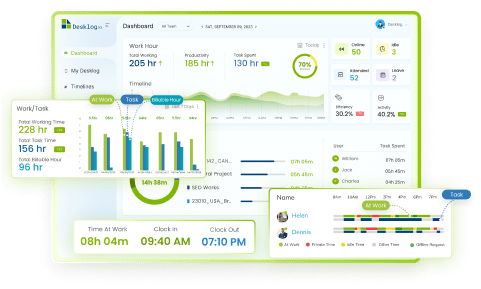
- Real-time dashboards: Track work as it happens, enabling faster responses to delays or capacity issues.
- Productivity analytics and trends: Identify which tasks, projects, or teams deliver the most value over time.
- Actionable business insights: Data-driven reporting highlights opportunities to improve workflows, planning and resource allocation.
3. Workforce Intelligence & Optimization
Workforce intelligence focuses on improving how work gets done, not just measuring it.
- Team performance insights: Understand how individuals and teams perform across tasks, projects, and time periods.
- Capacity and utilization analysis: Identify overworked teams and underutilized capacity to balance workloads more effectively.
- Task distribution recommendations: Support smarter task allocation based on availability, skills, and workload.
- Dedicated wellness module: Analyze work patterns and workload trends to help prevent burnout and support sustainable performance.
4. Remote & Modern Work Support
Designed for distributed teams, workforce-intelligent tools offer visibility without micromanagement.
- Insights for remote contractors and teams: Understand productivity and workload across locations without intrusive monitoring.
- Digital workforce analytics across tools and locations: Combine data from multiple apps, devices, and work environments into a cohesive view.
- Privacy-respecting activity tracking: Focus on aggregated patterns and trends rather than individual surveillance, maintaining trust and transparency.
A workforce intelligent time tracker empowers organizations to measure work meaningfully, optimize team performance, and make informed decisions, all while supporting employee wellbeing and modern work environments.
Conclusion
Time tracking laid the foundation for workforce management by recording hours, attendance, and activity. But as work has evolved into a distributed, collaborative and outcome-driven process, hours alone no longer explain productivity, performance, or wellbeing.
More data without context has only added complexity, not clarity. Workforce intelligence bridges this gap by turning work-hour data into meaningful insights.
By adding context, identifying patterns, and connecting time to outcomes, it helps organizations understand how work actually happens across teams, projects, and workflows. This shift enables smarter productivity management, balanced workloads, better collaboration and data-driven decisions without intrusive monitoring.
Unlock Workforce Intelligence Today
Turn your work hours into meaningful insights.
FAQs
1 What is workforce intelligence?
Workforce intelligence is an advanced approach to understanding how work actually happens. It goes beyond tracking hours to analyze work patterns, workflows, productivity and outcomes using data and analytics.
2 How is workforce intelligence different from time tracking?
Time tracking records when and how long people work. Workforce intelligence adds context by showing how time is used, where work slows down, and which activities drive real results.
3 How does workforce intelligence improve productivity?
It helps identify high-impact work, reduce low-value tasks, optimize focus, and measure outcomes instead of rewarding long working hours.
4 Can workforce intelligence help prevent burnout?
Yes. By analyzing workload distribution and work patterns, workforce intelligence detects overload early and supports healthier, more balanced workloads.
5 Is workforce intelligence suitable for remote and hybrid teams?
Absolutely. Workforce intelligence provides clear visibility into work without constant check-ins, making it ideal for remote, hybrid, and distributed teams.
6 How does workforce intelligence support better decision-making?
It provides real-time, data-driven insights that help leaders plan projects, forecast timelines, allocate resources, and improve processes proactively.
7 What features should a workforce intelligent time tracker include?
Key features include automated time and activity tracking, real-time analytics, productivity insights, workload optimization, and privacy-respecting tracking.
8 Why is workforce intelligence important for modern organizations?
With remote work, complex workflows, and changing priorities, workforce intelligence gives organizations the clarity needed to manage work effectively, improve performance, and support employee wellbeing.
Meet The Author

Co-founder and DevOps Manager at Desklog
